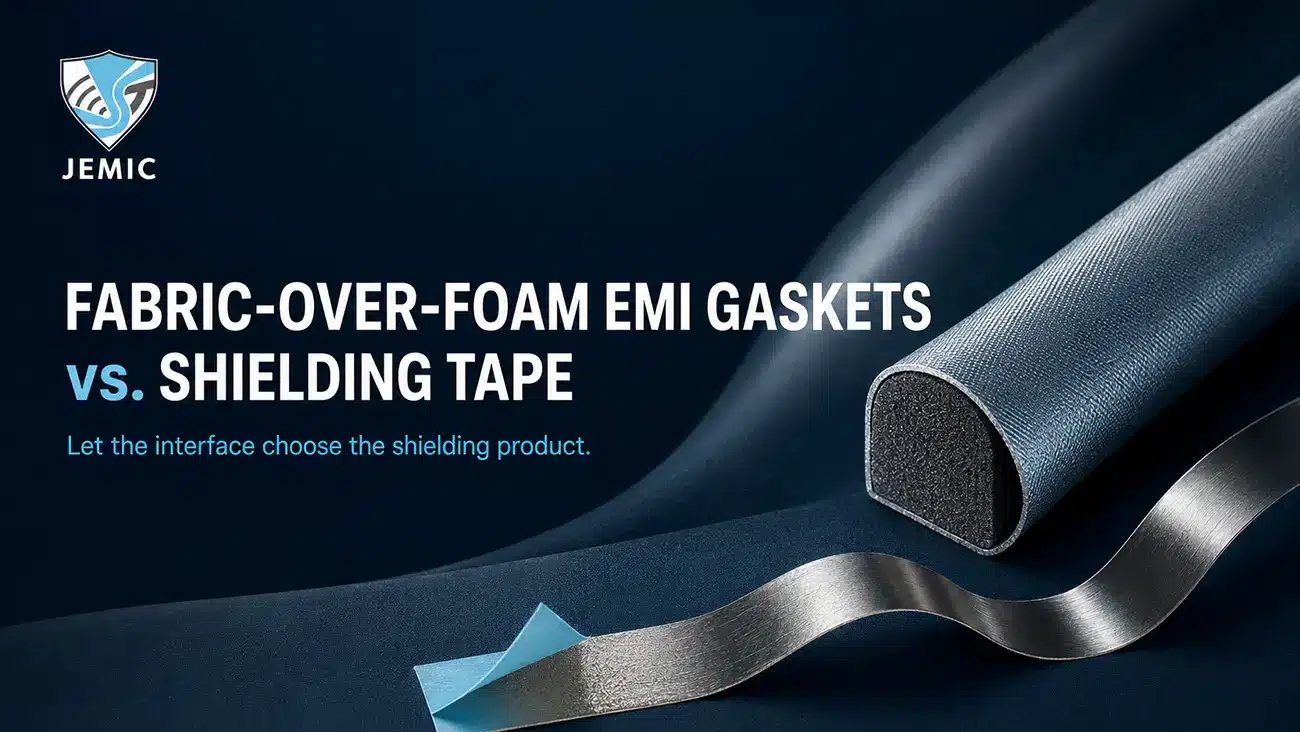
A conductive material can perform well on paper and still fail at the interface where it is installed. The problem often begins when shielding tape and fabric-over-foam gaskets are treated as interchangeable means of closing the same opening. One creates a thin conductive path across a relatively stable surface. The other maintains contact by compressing into a changing gap and recovering when the joint is reopened. Choosing between them starts with the interface’s mechanics, not the highest shielding value on a datasheet.
That distinction matters most when an enclosure must remain serviceable. A tape repair may reduce leakage during an initial test, yet become impractical when a technician needs to remove the cover. A gasket can accommodate that movement, but only when its profile and compression range match the joint. Neither product is inherently the better shielding solution. The correct product is the one designed to perform the mechanical work required at that specific interface.
Let the Interface Choose the Shielding Product
The first decision is whether the shielding path must move. A fixed seam presents a different problem from a door that will be opened during routine maintenance. An enclosure can lose shielding performance wherever an opening interrupts its conductive boundary, even when the surrounding housing is highly conductive. A 2023 peer-reviewed study in Energies examined field penetration through an aperture in a metallic enclosure and confirmed that an opening can materially affect the enclosure’s shielding behavior. Although the study addresses a high-power electromagnetic environment, its practical implications are broadly relevant: the integrity of the interface matters as much as that of the surrounding material. (Energies, 2023)
The next question is whether the interface will remain dimensionally stable. A rigid overlap with consistent contact may need only a thin conductive bridge, while a door or removable faceplate may require a material that tolerates changes in gap width. Fastener spacing and panel stiffness can create uneven compression along the same joint. Manufacturing tolerances can widen that variation across different units. If the shielding product cannot follow those changes, the conductive path may become intermittent even though the material itself has a strong attenuation rating.
Several interface conditions should be established before selecting either product:
- Will the joint be opened after assembly?
- Does the opening vary along the length of the seam?
- Is closure pressure available and reasonably consistent?
- Must the shielding material recover after repeated compression?
- Is the application a production interface or a localized repair?
- Does the available space permit a gasket profile, or only a thin tape construction?
Use Fabric-Over-Foam Where the Joint Must Compress
Fabric-over-foam gaskets are designed for interfaces that need both electrical continuity and mechanical compliance. The conductive metallized fabric provides the shielding surface, while the polyurethane foam core allows the gasket to compress against the mating surface. That construction makes the gasket relevant to enclosure doors, removable covers, and faceplates that must be accessed after assembly. The foam helps the shielding surface accommodate modest gap variations rather than relying on two rigid parts to remain continuously aligned. When the joint opens again, recovery becomes part of the gasket’s functional performance.
Profile selection determines whether that compliance works as intended. A gasket that is too tall may require more closure force than the panel or latching system can provide. A profile that is too short may never establish reliable contact across the entire seam. Excessive compression can also strain the fabric or impose unnecessary loading on the enclosure, while insufficient compression can leave areas of weak contact. JEMIC offers fabric-over-foam EMI gaskets in multiple profiles and sizes because the gasket must be matched to the available land area, gap, and closure mechanics. Custom configurations can also reduce installation complexity when a standard continuous strip does not suit the opening.
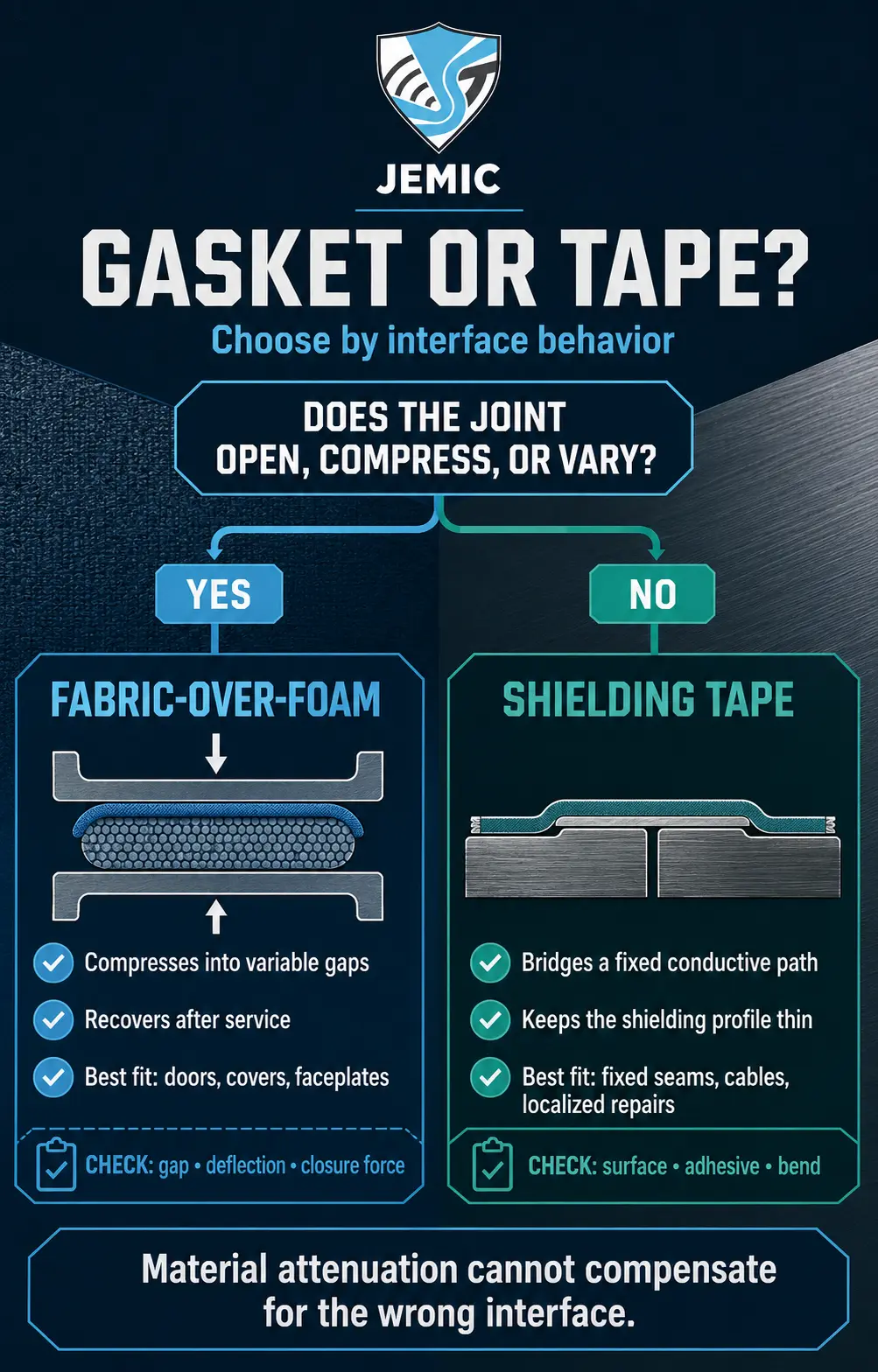
Fabric-over-foam is generally the stronger candidate when:
- A door, access panel or removable cover will be opened repeatedly.
- Panel deflection creates a changing gap along the seam.
- The interface needs a low-force compressible profile.
- The shielding contact must recover after servicing.
- A rigid conductive bridge cannot follow the enclosure geometry.
- Multiple gasket sections would be easier to install as a fabricated frame.
Environmental sealing should be evaluated separately rather than assumed from the presence of foam. A closed-cell core can contribute to a combined environmental and EMI solution, but the finished seal still depends on joint geometry and compression. Corners and transitions can create leakage paths when the gasket does not remain continuous around the opening. Surface finish can also affect the quality of electrical contact at the mating face. The gasket, therefore, has to be designed as part of the enclosure joint, not added after the mechanical design has already established every critical dimension.
Use Shielding Tape Where the Conductive Path Is Fixed
Shielding tape is better suited to surfaces that do not require meaningful gap filling or repeated mechanical recovery. It creates a thin conductive layer without adding the height of a compressible gasket profile. That makes tape useful for fixed seams, cable shielding, and localized areas where conductive continuity must be extended across a stable surface. It can also support repair and manufacturing work around printed circuit boards when the tape construction is compatible with the process. The adhesive and backing must remain appropriate for the substrate, geometry, and service environment.
JEMIC supplies both metal foil and plated conductive fabric tape because those constructions behave differently during installation. Foil provides a thin, conformable metal layer that can be useful on relatively smooth surfaces. Conductive fabric tape offers greater flexibility where the shielding path must wrap around a cable or follow less rigid geometry. Some foil constructions can accept solder, but solderability should be confirmed for the specific backing and adhesive, rather than assumed across all products. The choice within the tape category should follow the installation method after the interface has already been identified as suitable for tape.
- Copper foil tape:A versatile option for fixed conductive paths and applications in which copper compatibility or solderability is required.
- Aluminum foil tape:A lightweight foil option for bridging stable surfaces where the adhesive and mating materials are compatible with aluminum.
- Conductive fabric tape:Better able to follow flexible geometry, making it particularly useful for cable shielding and wrapped applications.
- Powder paint masking tape:Intended for manufacturing situations that require specified masking behavior during powder-coating operations.
Tape performance depends heavily on installation quality. Wrinkles and lifted edges can interrupt contact along what appears to be a completely covered seam. Contamination can weaken adhesion, while painted or oxidized mating surfaces may prevent the desired electrical connection. Tight bends can concentrate stress in the backing or adhesive, especially when the tape is forced to bridge an unsupported gap. A thin conductive layer works best when the underlying structure already provides a stable mechanical interface.
Bring JEMIC the Interface, Not Just a Material Request
The right conversation starts with how the joint closes, how often it opens, and how much its gap can change—not simply whether the drawing calls for tape or a gasket. JEMIC can help evaluate fabric-over-foam profiles and shielding tape constructions against the actual enclosure geometry, available closure force, and installation process. Send us the mating-surface details, expected movement, and relevant space constraints so we can narrow the options before a temporary shielding fix becomes a production problem.